
Weeing outside the litter tray can be a urinary problem (like cystitis): check with your vet first.
Puddle or spray? The answer changes everything you should do next.
If you've scrubbed the carpet, washed the duvet again, moved the tray, changed the litter and plugged in a diffuser, and you're still finding wee, you haven't failed. And your cat isn't doing it to spite you.
Most advice treats "weeing outside the tray" as one problem. Vet guidelines don't. The first thing they work out is whether it's a puddle (going to the toilet in the wrong place) or a spray (leaving a message). The two need completely different fixes, which is why a product that works for one can make no difference to the other.
Answer 9 quick questions about what you've seen.
- Your cat's probable type: puddle, spray or a mix of both
- Your most likely starting point, out of 5 causes
- Why what you've tried so far may not have worked
- A clear "see your vet" warning if anything you tick needs a vet first
Free · about 2 minutes · no sign-up needed. Not a diagnosis and not a replacement for your vet: it shows you the most likely place to start.
What are you finding outside the tray?
Where do you find it most often?
Pick the one that happens most. It's one of the biggest clues.
Have you ever caught your cat in the act?
Have you noticed any of these?
This is the most important question. Pick the first one that fits.
How many cats and litter trays are in your home?
Which of these is closest to your tray set-up?
Don't worry if you're not sure. Pick the closest.
What's going on at home?
And the spots themselves?
Last one: has a vet checked your cat since this started?
🔴 Phone your vet now
What you've ticked can be a sign of a blocked bladder. This is an emergency, especially in male cats, and it can't wait until morning. If your vet is closed, ring their out-of-hours number or the nearest emergency vet now.
Don't wait to see if it gets better, and don't try a home remedy first.
Why we're so firm: the UK vet charity PDSA advises contacting your vet immediately if a cat is struggling to wee and seems distressed, and describes a blocked bladder as an emergency.
Want a copy of your result?
We'll email it to you so you can find it again later or show it to someone at home. Just your result, nothing else.
Your result
Most likely: a puddle, not a spray
Your cat seems to be going to the toilet in the wrong place, not leaving a message. That's actually good news: it usually means something about the tray, the spot, the household or the body is putting them off the tray, and those are things you can change.
Why what you've tried may not have worked: calming plug-ins and stronger cleaners don't touch the reason a cat goes off its tray. If the real problem is the tray itself, the spot, or a niggle in the body, the shelf products miss it, however much you spend.
Most likely: a spray, not a toilet problem
Your cat seems to be leaving a scent message, not "missing the tray". Spraying is normal cat behaviour that has ended up in the wrong place, usually because something makes your cat feel their territory is under pressure.
Why what you've tried may not have worked: more trays, a new litter or a bigger box are fixes for a toilet problem. A spraying cat isn't looking for a toilet, so tray changes on their own rarely make a difference. What helps is working out what your cat feels they need to defend.
It could be either, or both
Your answers point both ways, and that's more common than you'd think. Some cats do both, and research shows no single sign reliably tells them apart.
Why what you've tried may not have worked: if two things are going on, a fix for one leaves the other untouched, so it looks as if "nothing works". Your plan starts with the most likely cause, and a simple tracker makes the picture clearer within the first week.
Plan A · Body first
Something in the body may be making the tray hard or uncomfortable to use: think sore joints, a sensitive bladder or something that makes them drink more. Your plan starts with the right questions for your vet, plus small, safe changes at home in the meantime (like a low-entry tray and a night light).
Plan B · The toilet itself
The size, number, litter, cleanliness or place of the trays may not be working for your cat. In one study, adult cats preferred a big tray (86 × 39 cm) to a smaller one. This is often the quickest place to see a change, and the plan works in a small flat too.
Plan C · Household stress and cat tension
Tension between cats, or changes at home, may be making the toilet feel unsafe. Cats are experts at quiet bullying: a stare across the hallway can be enough to keep another cat away from the tray. Your plan focuses on safe, separate resources and calm routines.
Plan D · Territory messages
Your cat may be marking, often because of the neighbour's cat at the window, a cat flap, new things or changes at home. A University of Lincoln study linked cat flaps and free outdoor access to more marking. Your plan focuses on what your cat feels they need to defend.
Plan E · The spot has become the toilet
Your cat may now prefer a particular place or surface (very often your bed or a soft rug) and traces of old wee you can't smell keep pulling them back. Some cleaners even make it worse: ammonia smells like wee to a cat. Your plan focuses on the spot, the smell and a better alternative.
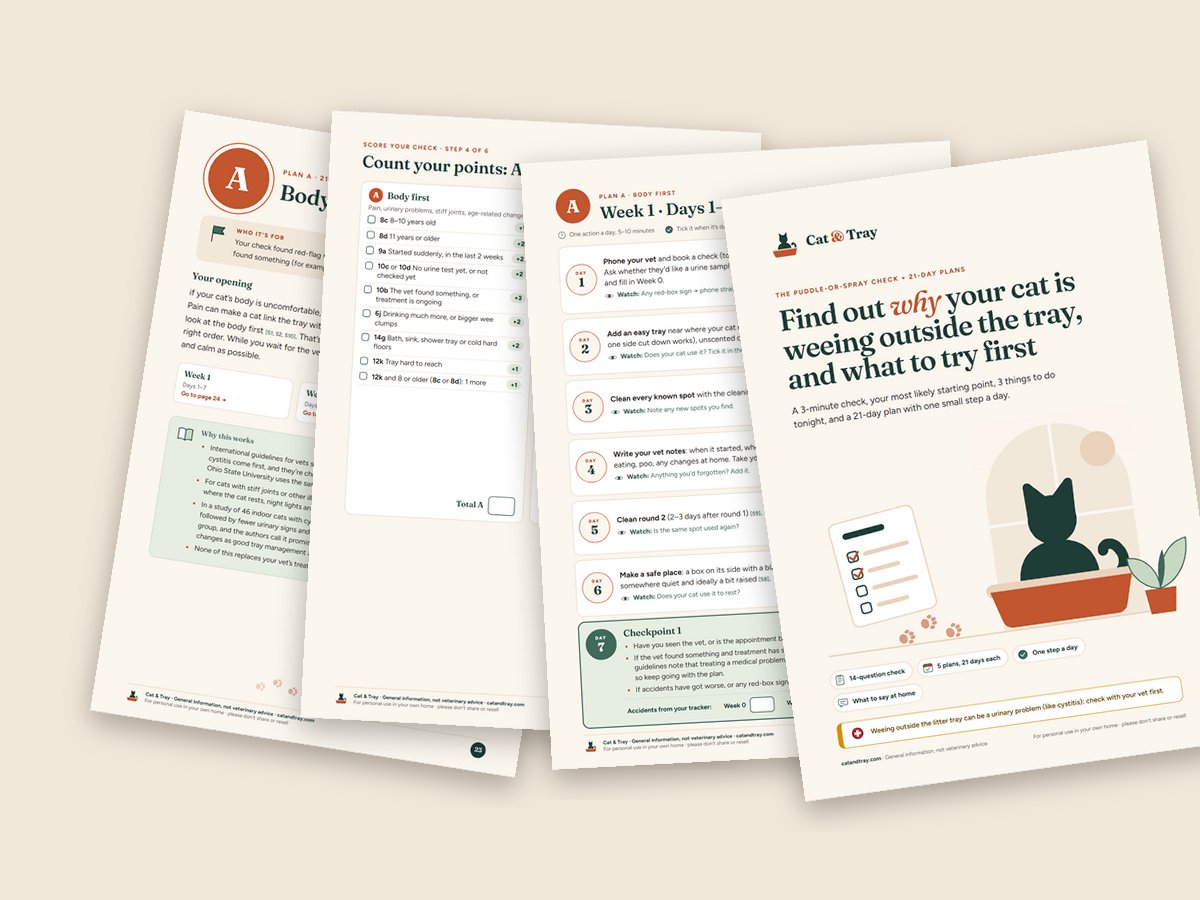
Now get the full check and your step-by-step plan
This free check gives you the direction. The full Puddle-or-Spray Check + 21-Day Plan gives you the map: the complete 14-question check, 3 things to do tonight, and one small step a day for the next 21 days, starting from your cat's most likely cause. At day 7 and day 14 your tracker tells you whether to stay on the plan or move to the next one, so you're never guessing again.
- The full 14-question check: puddle, spray or both, and your cause ranked out of 5, with the vet warning boxes
- Tonight's 3 actions: what to do before bed, so the next 24 hours start differently
- All 5 plans of 21 days: one small step a day, about 5–10 minutes, with "why this works" for each step
- The cleaning method from veterinary guidance: why bleach and some sprays can bring your cat back to the same spot
- The tracker: day 7 and day 14 checkpoints that tell you to stay or switch
- What to say at home: calm words for a partner or family who've started saying "rehome"
- Based on published vet guidelines and studies, with every source listed (not our opinion)
- Instant download (PDF) · one payment, no subscription
VAT included · One payment, no subscription · Instant download
30-day money-back guarantee
Try the plan for 30 days. If it isn't for you, for any reason, just email us and we'll refund every penny. No forms, no questions.